Let's Talk About the Fear of Feeling Behind In Your 20s

Hey, Hey....how y'all doing :) ?
It's been a longggg (emphasis on LONGGGGG) time since I've sat down and posted anything on this blog, but I'm back to posting Intentional Insights for the foreseeable future.
I've been working on applying for the 2027 doctorate cycle, and with that I started reflecting a LOT on how far I've come since I got my undergrad degree 3 years ago. It's crazy to see how far I've come, but it was crazier to realize that I didn't think about a single material accomplishment.
I looked at my success through how I've become more comfortable in my own skin, my thoughts, and my life as a person.
My version of me, and no one else's.
I didn't figure out what I wanted to do with my life until the my last semester of undergrad, and I remembered feeling SICK every time anyone asked me about what I was going to do with my life. I was finishing up my degree in Anthropology with a minor in Marketing.
I didn't have a LICK of an idea of what I wanted to do, but I DID have crippling anxiety, deep depression, and constant panic over one thing:
I was overwhelmingly afraid of falling behind.
That was the first moment I fully felt it.
The fear of falling behind reared its really ugly head at me as soon as I turned 20.
It was the first of many times that feeling would find me as things happened throughout my life.
The fear of falling behind was like continuing to get a call I didn't want--and I tried to block it out.
So many times.
It would creep up over and over, trapping me in a cycle of relentless questioning:
-
What if I can never move forward?
-
What if I wasn't meant for the things I want for myself?
-
What if life is on hard mode for me and easy mode for everyone else?
-
What if it would be less trouble to give up than to keep going?
and it sucked. overly.
but I kept pushing, kept looking for ways to make things work, and eventually, I got on the road of doing real shadow work: Deconstructing where this fear of feeling behind actually came from.
Once I started having honest conversations with myself (and then with everyone else), I started to find my way out.
Hopefully sharing my journey and learnings can help you find your way out of it too.
How the fear is made (and how it manifests)
The fear of falling behind can come from many things, but the easiest way we see it is in the ever existing form of constantly questioning if we're doing enough--to the point where the question itself stops being rational.
The feelings of not doing enough come from 3 key sources:
- Unfair/unmet expectations placed on you by others (whether intentional or not)
- Comparing yourself to others (and where they seem to be)
- Your internal drive (The motivation, and dedication when you want to do something)
the internal drive is the healthiest one.
Most people have a mix of all three, and when you mix 1 & 2 (when external pressure meets constant comparison), you start being unnecessarily hard on yourself.
it's like a hidden quest you weren't planning to unlock (but unfortunately did).
ask me how I know.
Now, take that feeling of "not doing enough" and add the weight of a world that looks nothing like what you were promised growing up.
- A global pandemic casting a shadow over your formative years and psychologically changing the world.
- An economy where the thought of buying a starter home feels laughable until you're thirty.
- A job market so unstable that chasing your dreams actually feels less risky than playing it safe.
- The socio-political landscape is changing at rates faster than anyone ever had to acknowledge
and this is all while you're trying to make a name for yourself, fight your own demons, find your people. Literally life on a super hard setting before you could even start.
Like why is everything like this when I start being an adult??
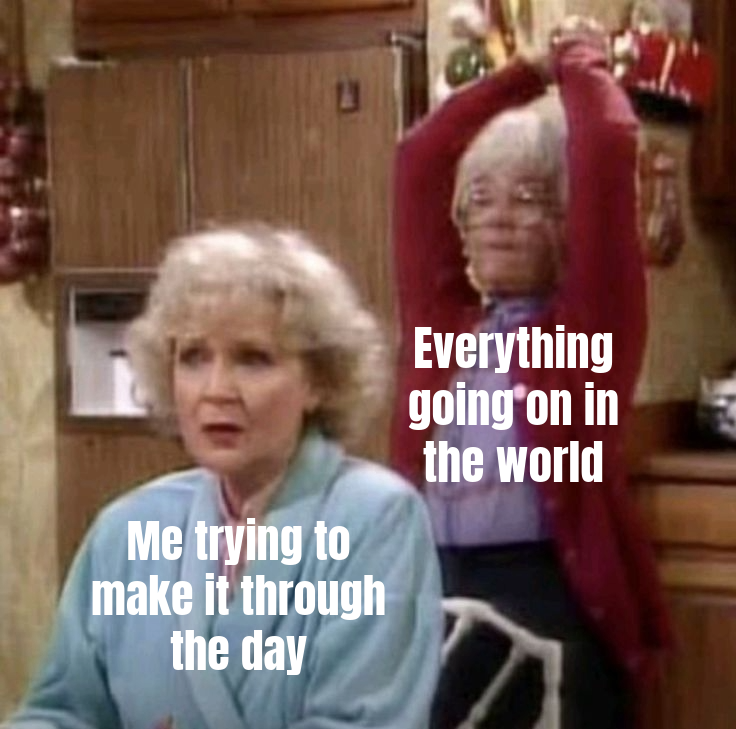
When you look at it like that, everything feels impossible. The fear of feeling behind becomes so real that it feelings like a physical weight on your chest.
on your life.
one that barely lets you breathe.
and honestly? it's extremely valid and real of you to feel that way.
I was there for a while. In some ways, I still am.
The thing about anything that feels impossible, though?
It doesn't last forever.
Not because the world gets easier (because it doesn't).
It's because you get better at navigating it.
and so, piece by piece, I started building a way out.
What I'm about to share are notttt quick fixes.
like, at all.
They're all came from uncomfortable conversations and honest reflections within my own experiences.
Ones that helped me build the mindset that keeps me moving and hoping, no matter what.
1) Finding a Method to Actually Focusing on What You Can & Can't Control
In theory, that sounds nice.
But as someone with anxiety? I need more than just a sentence. I need guidance. I need to know how to actually do that.
Here's what worked for me:
First, draw a literal line. I went on my notes app and literally wrote what's in my control and what isn't.
THEN I asked someone else who wasn't me (but knew me) to look at it, talk about it with me, and suggest any changes (because we often lock ourselves into feeling like we can control more when we can't.)
For my list of what I could control, I defined my fundamental unit of a win.
It's something I learned professionally, but applies to my personal world too.
The idea is simple: redefine what a "win" looks like. Instead of measuring success by massive, distant outcomes, shrink it down to something you can achieve presently.
Don't always define a win as something that "when this happens, I'll feel like I've made it" (or that it's a sign that you're making it).
There are so many small wins leading up to that big goal that deserve to be celebrated. They help you accept that you've done your best, and that's all that matters.
You're often winning a LOT more than you think. You just don't assign the same value to it.
- Submitting a quality application for a job you want is a win.
- Sending a text back to your friend group after being MIA for a week is a win.
- Going on a walk after doing something hard is a win.
You shrink the daunting future into a manageable present. You start building momentum, happiness, and resilience through noticing those small, consistent actions.
There's always something you can take away from every situation, and that something always makes you better prepared for what you face next.
For my list of what I can't control, I found (and now use) my angles of acceptance.
Angles of acceptance are the specific ways you choose to make peace with the things you cannot change.
It's not about pretending you're okay with something when you're not.
It's about finding a perspective that allows you to release the grip of fear of falling behind and redirect your energy toward what is within your control.
Like "rejection is redirection".
It doesn't erase the frustration, but it gives you a way to move forward instead of staying stuck in the spiral.
2) Recognizing the Comparison Trap & The Cost of Unnoticed Resentment
One of the biggest lessons I learned as I was starting out in corporate (and one that helped me avoid falling into comparison in my personal life and passions) was this:
Your emotions and perceptions, when you're constantly comparing yourself to others, are making you feel and think the absolute worst.
I saw and felt this firsthand: your emotions and perceptions of what people show publicly are actively distorting your private reality.
0/10. Do not recommend.
If you actually knew what it took for that person to get where they are (the sacrifices, the failures, the breaks, the amount of time, etc.) you probably wouldn't want to trade places.
Here's the other thing: We usually don't even want exactly what that person has. We want the feelings and lifestyle we think are associated with their success. The freedom. The validation. The security.
That illusion cycles us right back to feeling awful about what we don't have and wish we had by now.
When I watching one of Jackie Aina's videos one day, she said that when she feels jealous, she takes it as a sign that she's motivated for something.
and that stuckkk with me because yeah--I realized I felt that way too.
That jealously that I felt then was proof that I wanted something, then further proof that there was a version of myself that I was reaching for because I saw it was attainable from someone else doing or having it.
It's important to acknowledge when you feel jealous because feeling any emotion is human.
Don’t immediately deem yourself horrible for feeling it. Recognize it as a signal.
By acknowledging the jealousy or resentment without judgment (and without acting on it toward the person who invoked the emotion) you unlock the introspection needed to ask:
"What is it about their success that I actually want for myself?"
You're no longer playing in the invisible Olympics competition you've created inside your brain! You're getting inspired and you're learning.
You're putting the focus back on the thing that's important: Building You.
3) "Irritational Fear" vs. An Actual Wake-Up Call
The fear of falling behind doesn't just cloud our judgment on where we think we need to be. It can also stop us from actually listening to the people trying to help us get there.
Pleaseeeee don't jump me for this, but sometimes... we have to sit back and think about whether they might have a point.
Not all fear of falling behind is irrational.
It's only irrational when it's driven by external timelines and comparisons.
When the "where" and "when" aren't set by us and what we actually want for ourselves.
Irrational Fear is the panic that hits when you see someone else's accomplishment/life and feel like you're doing something wrong even when you're actually fine. It's rooted in comparison, external timelines, and societal or systemic pressure.
- Feeling like a failure because a former classmate bought a house at 25 (when you're still renting and perfectly okay with it).
- Spiraling because someone your age got promoted faster than you (when you're not even sure you want that role yet).
- Thinking you're "behind" because you're not married with kids by 30 (even though you're still figuring out what you actually want).
I was guilty of that second one when people had full-time offers before graduating. It was awful, but after being real with myself, I grew from it.
A Valid Wake-Up Call is the deep, nagging discomfort that comes when you know (and I mean really know) that something in your life needs to change.
- Feeling a persistent boredom or emptiness in your current role and realizing you haven't challenged yourself in a year.
- Knowing you've been coasting on a project because it's comfortable, even though you're capable of so much more.
- Realizing you're not moving toward your goals, but you're just staying busy at a place where you're fulfilling someone else's.
Valid wake-up calls are about alignment. It's your internal compass telling you that the path you're on isn't the one you actually want and making the changes to go and get it.
And when you're thinking about the change you need to make and immediately jumping to doing more, pause.
The effort of doing "more" first looks like:
- Honest self-awareness of what's actually wrong
- Being open to feedback from people who care about you even when it's uncomfortable
- Consistency of showing up for yourself, not for society or anyone else
- Having patience and confidence in your own path (even with the uncertainty of when you'll get there compared to other's journeys)
So the next time the fear hits, ask yourself:
"Am I feeling this way because of what someone else is doing, or am I feeling this way because I know I'm not showing up for myself?"
If it's the second one, use that energy you feel to make the change without internalizing the panic, because your brain and your gut are keeping you honest about your goals.
and if something brought the wake-up call to you: It's definitely not proof that the people pointing things out think less of you. Usually, they're seeing your potential and trying to help you step into it.
So those are three major reframes that really helped me find my way out of the "fear-of-falling-behind" beast's belly, but the biggest one was this:
Throughout life, it's going to come back.
The fear of falling behind doesn't disappear once you hit a certain age, land a certain job, or check a certain box. You'll see them again as you experience more.
The "falling behind" is a construct, not a fact. Your worth has never been tied to a timeline or other people's prophecies.
Lovingly build up the muscle to trust in yourself and your own pace.
Sooooo, yeah.
The fear of falling behind will probably whisper to you again.
Maybe next week. Maybe next year. Maybe when you're scrolling socials at 2 a.m. and wondering where everyone else is going while you're "standing still".
We can't make it go away forever.
but...
We can determine how we show up when it comes back.
your host & certified yapper,
~ Amaya :)

A Podcast In Progress #01: The Process Before Creating Your Platform